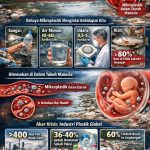
Gresik, 1 April 2026 – The latest research by ECOTON and South Korea’s Wonjin Institute has confirmed what we feared: microplastics are no longer just a river problem. They are silently flowing through our bodies.
KEY FINDINGS
100% of blood samples tested positive for microplastics
20 waste workers whose blood was examined
2018 when ECOTON began tracking microplastics in the Brantas watershed
0.45µm filter pore size — smaller than a red blood cell
Something has fundamentally changed in how we must think about plastic today. It is no longer about plastic bags floating in the Brantas River. Not about straws lodged in a sea turtle’s nose. Plastic is now inside our bodies — inside our bloodstream — and ECOTON’s research has just proven it with data.
In 2025, ECOTON and the Wonjin Institute from South Korea examined the blood of 20 waste workers. The results left no room for doubt: every single sample contained microplastics. Twenty out of twenty. One hundred percent. This is not an anomaly. This is an alarm.
“Microplastics are foreign particles with no biological function in the human body. Their presence can trigger oxidative stress, chronic inflammation, and hormonal disruption — and we cannot see them with the naked eye.”
— Sofi Azilan Aini, S.KM, ECOTON Researcher
The long road to a hard truth
ECOTON did not arrive at this finding overnight. Since 2018, we have traced the Brantas watershed — collecting samples of water, sediment, air, fish, and ultimately: human beings. In 2019, we examined the feces of residents living along the banks of the Surabaya River. Microplastics were present. We then examined breast milk, in collaboration with the Faculty of Public Health at the University of Jember. Microplastics were there too. And now, in blood — they are still there.
This is not coincidence. This is a pattern. And this pattern speaks to one thing: microplastic exposure in Indonesia has become ubiquitous — everywhere, almost unavoidable, happening every day without our awareness.
The plastic that enters our blood is not plastic we can see. It is the product of degradation — fragments and ultra-fine filaments that slip past the body’s defenses in the gut lining and lungs, then enter the circulatory system. The body does not know what to do with them.
Not just waste workers — this is about all of us
It is tempting to think: “Those are waste workers — their exposure must be far higher than mine.” But ECOTON did not stop there. We are now extending our research to public health students in Malang — young people who do not work at dumpsites, who eat, drink, and breathe just like the rest of us.

Because the pathways in do not require direct contact with a pile of garbage. The food we consume. The water we drink. The indoor air we breathe. The synthetic clothing we wear. All of these routes are active every single day — and all of them potentially carry microplastics into our bodies.
“This is not an emergency in the classical sense — no one is falling sick from microplastics today. But that is precisely what makes it dangerous. It works in silence, chronically, cumulatively. The effects only reveal themselves years later.”
— Sofi Azilan Aini, S.KM, ECOTON Researcher
What happens after plastic enters the blood?
The human body does not recognize plastic as a friend. When these foreign particles enter the bloodstream, the immune system reacts — triggering chronic inflammation that persists continuously with no symptoms we can feel. Over time, this can contribute to cardiovascular disease, metabolic disorders, and declining organ function.
Certain polymers such as polystyrene have even been linked to changes in the blood clotting system — raising the risk of thrombosis and microcirculatory disruption. The direct causal relationship in humans is still being studied. But the risk signals, scientists say, are already too strong to ignore.
This research is a weapon for advocacy

ECOTON does not conduct research simply to fill scientific journals. Every piece of data we gather is ammunition to push for bolder policy: stricter controls on single-use plastic production, serious waste management reform, and public health protections that can no longer be delayed.
Indonesia is one of the world’s largest producers of plastic waste. Yet scientific data on the health impacts of microplastics on the Indonesian human body remains extremely scarce. ECOTON’s research exists to fill that void — built on rigorous methodology, contamination-free protocols, and conclusions that cannot be dismissed.
Because ultimately, we cannot protect what we do not measure. And what we have measured today, we must not ignore tomorrow.
Tags: Microplastics • Public Health • ECOTON Research • Brantas Watershed • Plastic Pollution • EDCs
Plastic is already in our blood. Help spread the truth.
The more people know, the greater the pressure for real policy change. Share this article with anyone who cares about their health — and the health of all of us.
ecoton.or.id

 Ecoton (Ecological Observation and Wetlands Conservation) is a foundation focused on the conservation of river ecosystems and wetlands in Indonesia. We conduct scientific research, environmental education, and awareness campaigns to improve water quality and protect biodiversity.