Surabaya, 12 May 2026
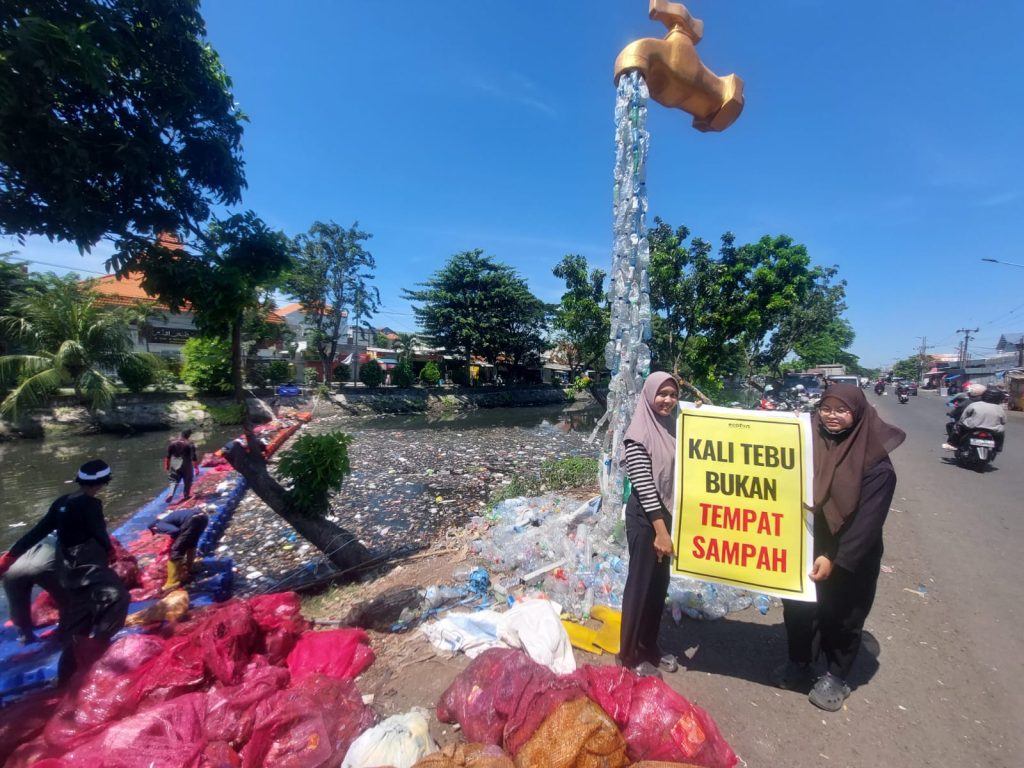
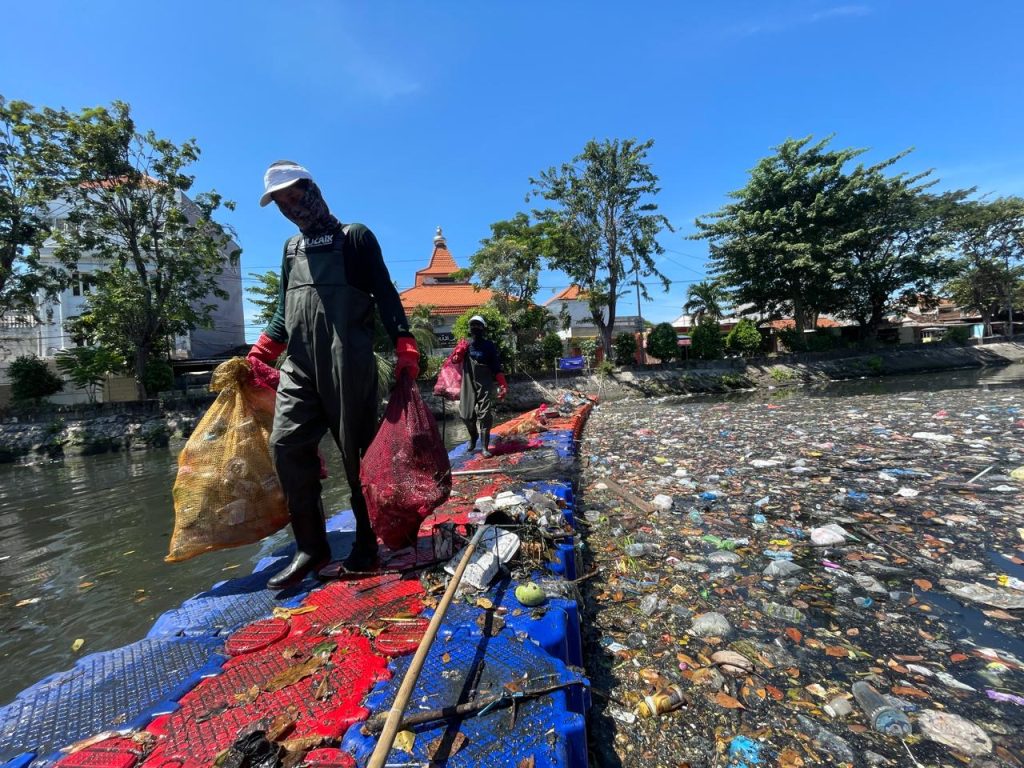
When the Barakuda surfaced from Kali Tebu on Monday morning, it revealed the staggering scale of Kali Tebu waste. Styrofoam blocks, single-use plastic bags, food wrappers, and household waste had packed so densely they formed a floating mass in the current. This is what North Surabaya’s river carries every single day — mostly unseen, mostly unacknowledged — until a net stops it and the evidence becomes impossible to ignore.
A Coalition Acts on Kali Tebu Pollution
Ecoton and Komunitas Pemuda Kali Tebu (Pekat) first installed the Barakuda trash-trapping device on Sunday, 10 May 2026, at Platuk Donomulyo Utara, Kelurahan (urban ward) Sidotopo Wetan. Just twenty-four hours later, 25 young volunteers gathered at the riverbank. They came from UINSA’s Marine Science department, UNESA’s Biology department, and Ecoton’s own team. Together, they drained and evacuated what the Barakuda had caught overnight. What they pulled out was, in miniature, a portrait of a city’s waste crisis.
Muhammad Isomudin, Chair of Pekat, was direct about his motivation. “As residents of Surabaya, we feel called to make rivers in this city free from plastic waste. I want concrete action to clean up Kali Tebu,” he said. His vision is Kali Tebu Moncer — a river clean enough to become a site of community pride, and eventually a local tourism destination. That vision sounds ambitious against the backdrop of a waste-choked waterway. Yet it is precisely the kind of civic imagination that river recovery demands.
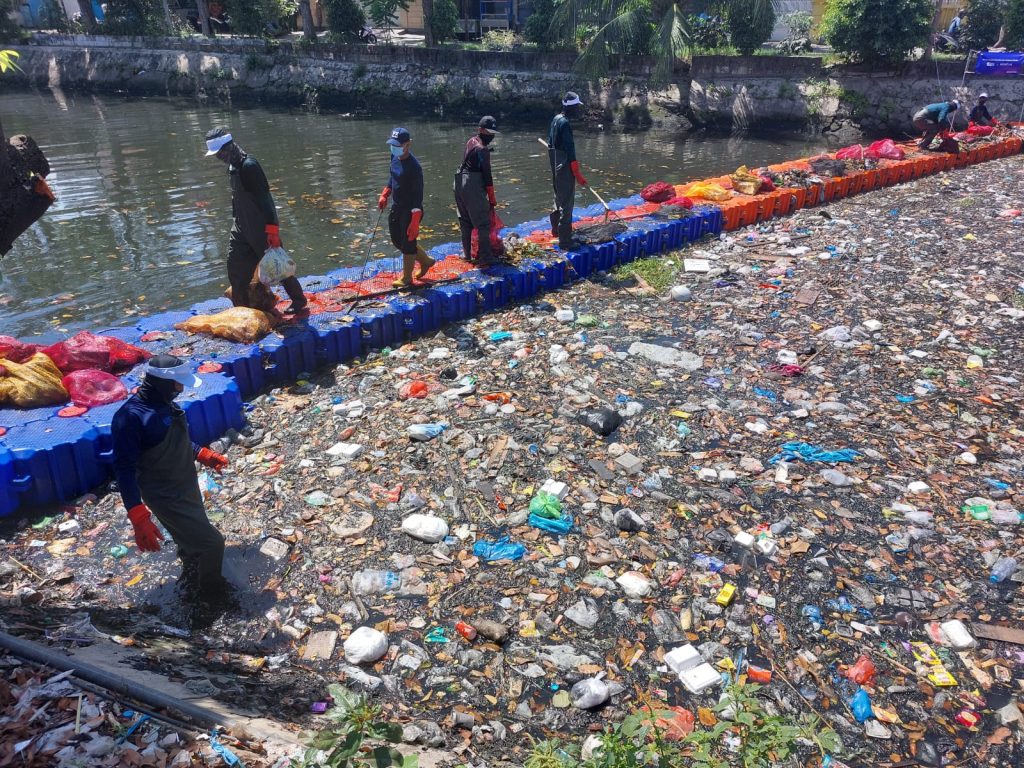
Cleanup teams transport collected waste during a plastic pollution cleanup at Kali Tebu.
A Failure of Systems, Not Just Behavior
Imagination alone, however, cannot clean a river. The Kali Tebu plastic waste problem did not arrive by chance — it arrived through a failure of systems. Specifically, inadequate waste infrastructure in densely packed settlements forces plastic toward the path of least resistance. In urban Surabaya, that path runs directly into the river. For years, the response focused almost entirely on the downstream end: removing what accumulated, while doing little to stop what kept flowing in. As a result, the problem never truly shrank — it only moved.
Ecoton has long argued that this approach manages the symptom while the disease continues upstream. That is exactly why the Barakuda at Kali Tebu is permanent, not temporary. Under Ecoton’s MOZAIK Program — a collaborative initiative driving river recovery through waste monitoring, community education, and policy advocacy — drainage runs every two days. Furthermore, each cycle will be followed by a brand audit: a systematic sorting of plastic waste by producer and brand, conducted at TPS3R Kedung Cowek, Bulak.
Amiruddin Muttaqin, MOZAIK Program Manager, explained why the brand audit matters beyond the cleanup itself. “After drainage, we will conduct a brand audit to identify the sources of plastic waste,” said Amir. Consequently, these audits build the evidentiary foundation for Extended Producer Responsibility advocacy. In other words, they name who manufactured the plastic now choking Kali Tebu — and make the legal and moral case that producers, not just communities, must bear accountability.
Government Must Convert Momentum into Policy
Meanwhile, the excavation drew an important figure to the riverbank: M. Fikser, Acting Head of the Surabaya City Environment Agency. His presence was more than symbolic. Indeed, river pollution in Surabaya has reached a scale that community action alone cannot resolve. Fikser acknowledged this openly. “The work done by Ecoton and Pekat has a time limit. What matters is how the city government can follow up this movement with long-term policy and action,” he said.
He then outlined two immediate steps the city is preparing. First, waste barriers at every RW along Kali Tebu’s course — spreading monitoring responsibility across the entire watershed rather than concentrating it at the mouth. Second, the drafting of a Mayor’s Regulation (Perwali) specifically governing Kali Tebu’s management and protection. In addition, Fikser addressed a long-standing grievance: downstream communities have carried the blame for waste that originates far upstream. As a result, he committed to changing that dynamic, recognizing that accountability must run across the whole river corridor.
Kali Tebu Plastic Waste Reaches the Human Bloodstream
Among the volunteers, the emotional response was just as striking as the physical evidence. Ladya Dwi Kurnia Putri, a Biology student from UNESA, described feeling “sad and concerned” at what she witnessed firsthand. “The community along Kali Tebu must stop treating the river as a trash bin — and the government must provide adequate waste facilities,” she said. Similarly, her fellow student Muhammad Rofiul Ihsan raised a finding that shifts the urgency from visible to invisible: Kali Tebu already carries microplastic contamination.
What the eye sees floating on the surface is, therefore, only part of the problem. Beneath it, plastic has broken down into particles invisible to the naked eye. These particles enter the water column, absorb into aquatic organisms, and gradually move up the food chain — toward every household that depends on this watershed.
Moreover, this is not a distant risk. Ecoton’s 2025 blood microplastics research found microplastic particles in human blood samples. As a result, the pipeline from polluted river to human body is already open, and Kali Tebu feeds it. Cleaning the surface matters — but lasting protection requires systemic change: waste infrastructure that reaches every household, producer accountability enforced by law, and a city government that treats its rivers as protected public assets rather than managed inconveniences.
One Morning, One River, One Larger Argument
Ultimately, Monday’s action was one morning on one river. Nevertheless, Ecoton and Pekat have staked something larger in it — the argument that community will, scientific evidence, and sustained policy pressure, applied together over time, can turn a waterway back from the edge. Kali Tebu has not crossed a point of no return. The question now is whether this momentum builds into something permanent. The Barakuda sits in the water. The brand audit data accumulates. The Perwali draft moves forward. Will these translate into lasting river protection — or dissolve, as so many cleanup actions before them have, into a single morning’s worth of photographs and goodwill?
Rivers remember everything they carry. The people of North Surabaya are asking, not unreasonably, that their river be allowed to carry something different.
 Ecoton (Ecological Observation and Wetlands Conservation) is a foundation focused on the conservation of river ecosystems and wetlands in Indonesia. We conduct scientific research, environmental education, and awareness campaigns to improve water quality and protect biodiversity.